

Leadership Execution Institute Maps Where Strategy Loses Force on the Way to the Frontline
News originally published by
EIN Presswire
The Leadership Execution Institute maps where strategy loses force between the plan and frontline work, in The Drift Tax by Jim Rembach.

From Chapter 1 of The Drift Tax by Jim Rembach.

Jeff DeGraff, Clinical Professor at Michigan Ross, on The Drift Tax.
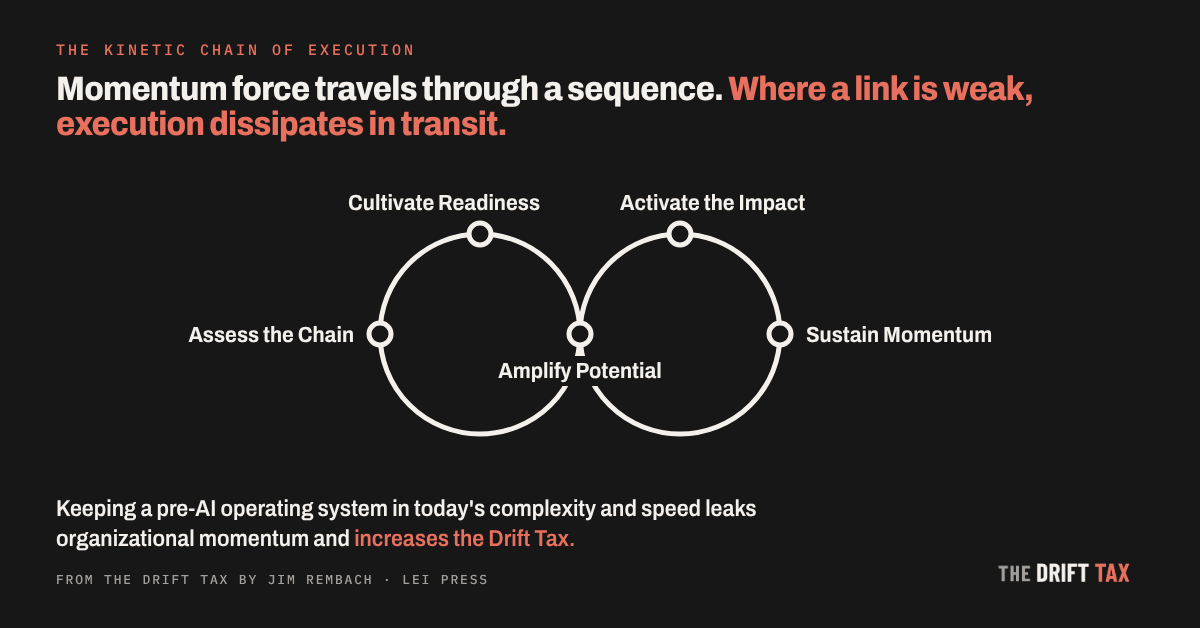
The Kinetic Chain of Execution, from The Drift Tax by Jim Rembach: keeping a pre-AI operating system in today's complexity and speed leaks organizational momentum and increases the Drift Tax

The Drift Tax by Jim Rembach, an Amazon Best Seller in two Business & Management categories.
Jim Rembach's Amazon Best Seller The Drift Tax traces where strategic intent loses force between the plan and frontline work, as 2027 budgets are approved.
Jim Rembach, the institute's Executive Director, wrote the book. LEI Press, its publishing division, released it on October 12. Within days it was an Amazon Best Seller in two Management & Leadership categories. One section of the sixth chapter, "The Tax Collector Loves November," is set in the annual planning cycle, when next year's budgets are approved.
How does a fastball explain a strategy?
The model comes from human movement. Rembach is a SAVAGE certified baseball pitching coach, and in the book a fastball's force starts in the ground. It is generated through the legs, then transferred and amplified through the hips and torso before it leaves the fingertips. "When the sequence works, every link amplifies what the link before it produced. The arm generates the least amount of force in the chain and primarily acts as the release point for all system-generated force."
The institute calls the organizational version the Kinetic Chain of Execution, the sequence through which strategic intent becomes actual behavior and, eventually, a result that generates velocity and momentum. The book maps it directly. "Strategy is the legs. Structure is the hips. Management is the torso. And the frontline, where an actual human does an actual thing a customer actually experiences, is the arm."
As a strategy moves through the chain, it becomes work to be done. Each link is meant to act as a force multiplier. When one can't, the work still reaches the people serving customers, with less behind it and more for them to make up. The 2025 paper Talent Recalibration (DOI 10.5281/zenodo.19897431) sets out the model in full.
Where did the strategy stall in the book's case?
In the book's first chapter, a supply chain analyst raises a bottleneck between procurement and fulfillment on a weekly call. A capable vice president asks a clarifying question and suggests the two departments take it offline. The meeting moves on. The exchange lasts eleven seconds. "No malice. No incompetence." Three weeks later the bottleneck is a missed commitment to a major customer.
Rembach is precise about where it broke. "The strategy did not fail at the top, and the frontline did not suddenly become incapable at the bottom. The transfer failed in the middle, where coordination had to move across a seam and did not."
Most of the causes belong to the company. Rembach says they vary and keep shifting. Resource constraints, inadequate tools, outdated processes, and a work environment that does not reinforce the standard all play a part.
The institute's research brief The FONE Factors and the Science of Momentum reaches the same point from published survey data. It names the tier that translates senior intent into day-to-day work as the place where execution currently breaks most visibly, and it describes that tier as running on empty while carrying the heaviest behavioral load.
Where should a 2027 budget aim?
In pitching, the book says, when the force is not there, the pitcher "tries to make it himself by forcing the arm to generate it." In companies, the strain shows up with the people serving customers. Turnover climbs. Customer satisfaction and engagement scores slip. Defects and rework pile up.
That is where the next round of remedies lands, and the book names the reflex. "Executives keep trying to throw harder with the arm, placing more pressure on the last link."
Rembach's advice to a budget owner is to read those symptoms first, then trace the causes upstream before funding a fix. The cause may sit two links back.
The FONE brief addresses finance and operations leaders together. It puts manager-layer capacity in the same conversation as the return on change spending, and it advises starting the diagnosis at the translation handoff rather than with another frontline communication push.
What separates the one company in five that wins?
The book cites McKinsey's profile of Strategy Champions, the roughly one in five companies that win. McKinsey describes them as even better at mobilizing execution than at crafting strategy. They assign single-owner accountability for delivery and test how the work is actually being done. Rembach reads that as companies that gave the behavioral layer an owner, a seat the book calls the empty chair. "McKinsey found the empty chair too. They just didn't name it."
How has the book been received?
"Change rarely happens all at once. More often, we drift, one small compromise at a time, until where we are is a long way from where we intended to be. Jim Rembach's The Drift Tax shows leaders how to recognize that drift, confront it, and get moving in the right direction again," said Jeff DeGraff, Clinical Professor of Management and Organizations at Michigan Ross, co-creator of the Competing Values Framework, and author of The Art of Change.
Where can a budget team get a first reading?
Before the money is committed, a leadership team can check how its own chain holds. The book's Drift Tax Diagnostic scores ten statements about an ordinary Tuesday across five dimensions. One of them, Signal Visibility, asks whether concerns travel directly to the people who own them. The diagnostic is free at diagnostic.thedrifttax.com and returns an Architecture Score with an Exposure Report naming the weakest area.
The Drift Tax is sold in hardcover, paperback, ebook, and audiobook editions through Amazon and major retailers. Excerpts are at www.thedrifttax.com.
About The Drift Tax
The Drift Tax: Why Organizations Pay Twice for the Same Performance and How to Stop, by Jim Rembach, is published by LEI Press and was released October 12, 2026, in hardcover (ISBN 979-8-90589-141-0), paperback (ISBN 979-8-90589-140-3), ebook (ISBN 979-8-90589-139-7), and audiobook (ISBN 979-8-90589-142-7). It is about the hidden taxes organizations pay when their people drift, causing execution failures, and how to stop paying them. www.thedrifttax.com
About Jim Rembach
Jim Rembach is the Executive Director of the Leadership Execution Institute and President of Execution Architects, where he helps organizations design and implement the scaffolding needed to upgrade their operating systems for the post-AI era. He is the author of The Drift Tax and the host of the Fast Leader Show, where he has interviewed hundreds of the world's most influential management thinkers. He spent three decades inside complex operations before writing the book. He lives in Greensboro, North Carolina.
About LEI Press and the Leadership Execution Institute
LEI Press is the publishing division of the Leadership Execution Institute, an independent research organization studying leadership behavior, behavioral drift, and culture-calibrated execution systems in modern organizations. The institute's research briefs, reports, and publications are available at leadershipexecutioninstitute.org.
Review copies and interviews are available on request.
Emma Allen
Leadership Execution Institute
+1 336-202-1032
press@leadershipexecutioninstitute.org
Visit us on social media:
LinkedIn
YouTube
Legal Disclaimer:
EIN Presswire provides this news content "as is" without warranty of any kind. We do not accept any responsibility or liability for the accuracy, content, images, videos, licenses, completeness, legality, or reliability of the information contained in this article. If you have any complaints or copyright issues related to this article, kindly contact the author above.
